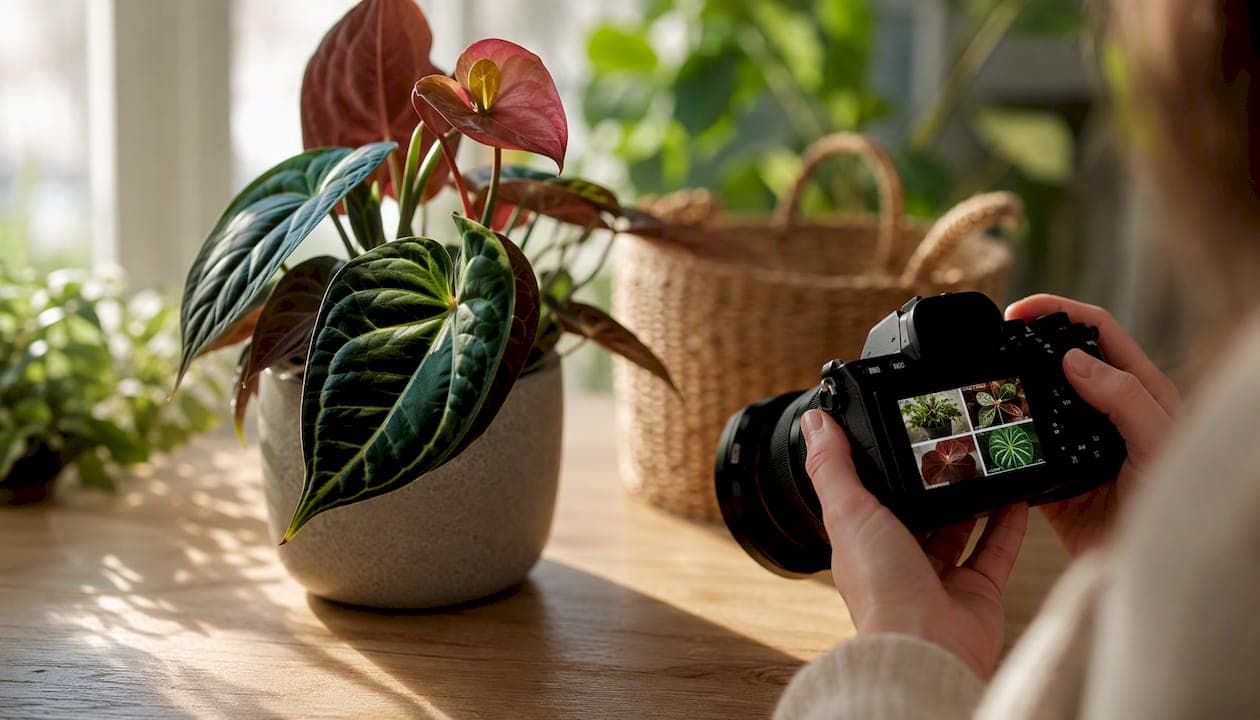
You can identify most common houseplants in under five minutes by taking four reference photos and running them through a visual checklist that targets family-level traits. That's the short version. Here's what to do right now:
- Snap four shots: full plant habit (the whole thing, pot included), top of a mature leaf, underside of that same leaf, and any standout feature (aerial roots, unusual stem, flower, or variegation pattern). Natural daylight, no flash, no backlight.
- Check pet-toxicity immediately if you have cats, dogs, or small children nearby. The ASPCA Animal Poison Control Center database is the go-to U.S. resource.
- Look up basic care once you have a likely name: light preference, watering frequency, and humidity needs are all species-specific, so a wrong ID leads to genuinely wrong care.
Pro Tip: Photograph the potting medium too. Chunky bark screams orchid; gritty, sandy mix points to succulents. That single detail can eliminate half the wrong guesses before you even open an app.
| Point | Details |
|---|---|
| Four reference shots | Full habit, leaf top, leaf underside, unique feature — in natural daylight |
| Pet-toxicity first | Check ASPCA before handling unknown plants if pets or kids are present |
| ID unlocks care | Species-specific light, water, and soil needs only make sense after a correct ID |
| Cross-reference rule | Confirm with at least two independent sources before changing care routines |
| Planthead | Log photos, set care reminders, and flag toxicity notes all in one place |
Key Takeaways
Correct houseplant identification requires four reference photos, verification against at least two independent sources, and an immediate pet-toxicity check before changing any care routine.
| Point | Details |
|---|---|
| Four reference shots | Capture full habit, leaf top, leaf underside, and a unique feature in natural daylight. |
| Verify with two sources | Confirm the app's suggestion against Kew POWO or an extension guide before acting on it. |
| Check ASPCA for toxicity | Many common houseplants are toxic to cats and dogs; verify every new plant before it settles in. |
| Adjust care conservatively | After ID, move to correct light and pause watering until you know the plant's history. |
| Planthead | Log your ID photos, set care reminders, and flag toxicity notes all in one ad-free app. |
Table of Contents
- How to follow a houseplant identification guide step by step
- Photo apps vs. manual ID vs. community help: which one fits your situation?
- 12 common houseplants: quick visual ID cues, care, and pet-toxicity
- How to confirm an ID and avoid the most common mix-ups
- What to do right after you identify a plant (including the pet-safety check)
- Common lookalike pairs and the one detail that tells them apart
- The four-shot photo protocol that experts actually use
- Why identification is a skill worth building, not just a one-time scan
- Planthead turns your ID into a full care routine
- Sources
How to follow a houseplant identification guide step by step
A repeatable workflow beats a one-off lucky guess. Here's the sequence that works whether you have an app or just your eyes.
-
Capture the four reference shots. According to photo protocol guidance from the Southeastern Grasslands Initiative, the four shots that minimize ID errors are: full growth habit, top of a mature leaf, underside of that leaf, and any unique feature (aerial roots, cataphylls, flower, or unusual stem). Shoot in natural daylight, keep the background plain, and avoid backlighting.
-
Note non-visual context. What's the potting medium? Where did the plant come from (a big-box store, a specialty nursery, a friend's cutting)? Provenance narrows the field fast. A UConn Home & Garden factsheet on potting media confirms that professionals use potting medium as a diagnostic clue before they even look at the leaves.
-
Run a photo-ID app. Submit all four shots, not just one. Accuracy improves noticeably with multiple angles, and background clutter reduces it.
-
Compare the top result against a visual reference. Pull up a second source (a botanical database, an extension guide, or a community forum) and check that the leaf shape, venation, and growth habit actually match your plant.
-
Decide: "likely" or "confirmed." Call it confirmed only when leaf shape, texture, growth habit, and at least one small distinguishing feature (variegation pattern, cataphylls, node structure) all line up across two independent sources. If even one feature doesn't match, treat the ID as likely and re-scan after a week or two when you can photograph new growth.
-
Log the result with your photos. Date-stamp everything. If you revisit the ID later, you'll want to see what the plant looked like at this exact stage.
Pro Tip: Young leaves on Monstera, Philodendron, and several other aroids look completely different from mature ones. If your plant is juvenile, search specifically for "juvenile [species name] leaves" rather than the standard species image.
Photo apps vs. manual ID vs. community help: which one fits your situation?
Each method has a sweet spot. Knowing which to reach for first saves real time.
| Method | Speed | Accuracy (common species) | Photos required | Cost |
|---|---|---|---|---|
| Photo-ID app | Seconds | High for common species; lower for rare cultivars | 1–4 (more = better) | Free tiers available; premium unlocks more IDs |
| Manual visual ID | Minutes to hours | High when you know family markers; low for beginners | None (uses your eyes) | Free |
| Community forum / group | Hours to days | Very high, especially for unusual cultivars | 2–4 (habit + leaf detail) | Free |
When to use a photo app: You need a quick answer right now. Maybe you just bought a mystery plant, or you're at a nursery and want to know what you're looking at before you buy. Apps are fast and surprisingly accurate for the 20 or so most common houseplants. The tradeoff is that a single blurry photo can produce a confident-sounding wrong answer.
When to go manual: You're trying to actually learn the plant, not just label it. Purdue Extension notes that identifying plants by sight is a practiced observational skill, and learning family-level markers (like the waxy, heart-shaped leaves typical of aroids) helps you catch when an app suggestion is probably off. Manual ID is also the right call when you want to understand why a plant needs what it needs.
When to ask a community: You've got an unusual cultivar, a variegated sport, or a plant that two apps disagreed on. Plant communities on Reddit (r/whatsthisplant, r/houseplants) and Facebook groups can be remarkably accurate because experienced collectors have seen thousands of cultivars in person. The wait is longer, but the answer is often more nuanced.
For a deeper look at how these apps compare on accuracy and features, the Planthead blog's app comparison breaks down the options honestly.
12 common houseplants: quick visual ID cues, care, and pet-toxicity
Beginner-friendly visual guides recommend starting with leaf shape, texture, and growth habit, then confirming with smaller details like variegation or cataphylls. Here's that logic applied to the twelve plants you're most likely to encounter.
-
Pothos (Epipremnum aureum): Heart-shaped leaves, often with yellow or white variegation, trailing or climbing vines, and visible aerial roots at nodes. Leaves are slightly thicker and more puckered than a philodendron's. Care: Low to bright indirect light; let soil dry between waterings. Toxicity: Toxic to cats and dogs (ASPCA).
-
Monstera deliciosa: Large, glossy leaves with dramatic fenestrations (the iconic "Swiss cheese" holes) on mature plants. Juvenile leaves are solid and heart-shaped, which trips up a lot of people. Thick aerial roots emerge from nodes. Care: Bright indirect light; water when the top 2 inches of soil are dry. Toxicity: Toxic to cats and dogs (ASPCA).
-
Philodendron (common species): Heart-leaf philodendron (P. hederaceum) has thinner, softer, more matte leaves than pothos, with a distinctive cataphyll (papery sheath) at new growth. Upright species like P. bipinnatifidum have deeply lobed leaves. Care: Medium indirect light; moderate watering. Toxicity: Toxic to cats and dogs (ASPCA).
-
Fiddle-leaf fig (Ficus lyrata): Large, violin-shaped leaves with prominent veining and a leathery, wavy texture. Upright tree form, single trunk in most nursery specimens. Care: Bright indirect light; hates being moved. Water when the top inch of soil is dry. Toxicity: Toxic to cats and dogs (ASPCA).
-
Snake plant (Dracaena trifasciata, formerly Sansevieria): Stiff, upright sword-shaped leaves with horizontal banding and often a yellow margin. Nearly impossible to confuse once you've seen one. Care: Tolerates low light; water sparingly (every 2–6 weeks). Toxicity: Toxic to cats and dogs (ASPCA).
-
ZZ plant (Zamioculcas zamiifolia): Glossy, dark green oval leaflets arranged in pairs along arching stems, growing from a thick underground rhizome. Feels almost plastic. Care: Low to medium indirect light; drought-tolerant. Toxicity: Toxic to cats and dogs (ASPCA).
-
Pilea peperomioides: Round, coin-like leaves on long petioles that attach at the center of the leaf (peltate), giving it a pancake or UFO look. Wikipedia's entry on Pilea peperomioides confirms this rosette/pendant growth habit is the key ID marker. Care: Bright indirect light; let soil dry between waterings. Toxicity: Non-toxic to cats and dogs (ASPCA).
-
Aglaonema (Chinese evergreen): Lance-shaped leaves with bold variegation in green, silver, pink, or red depending on cultivar. Stems are thick and cane-like. Care: Low to medium indirect light; water when the top inch of soil is dry. Toxicity: Toxic to cats and dogs (ASPCA).
-
Calathea / Maranta (prayer plants): Oval leaves with intricate patterned markings on top and often purple or burgundy undersides. Leaves fold upward at night (nyctinasty), which is a fun party trick and a reliable ID clue. Care: Medium indirect light; keep soil consistently moist; high humidity preferred. Toxicity: Non-toxic to cats and dogs (ASPCA).
-
Spider plant (Chlorophytum comosum): Long, arching, strap-like leaves, often with a central white or yellow stripe. Produces dangling "siderites" (baby plantlets) on long runners. Care: Bright to medium indirect light; water moderately. Toxicity: Non-toxic to cats and dogs (ASPCA).
-
Aloe vera: Thick, fleshy, lance-shaped leaves with serrated edges and a gel-filled interior, growing in a rosette from a central base. Grayish-green with occasional white spots on younger leaves. Care: Bright direct or indirect light; water deeply but infrequently. Toxicity: Toxic to cats and dogs (ASPCA).
-
Boston fern (Nephrolepis exaltata): Arching fronds with many small, evenly spaced pinnae (leaflets) along each frond. Lush, feathery texture. No flowers, no variegation. Care: Medium indirect light; keep soil moist; high humidity. Toxicity: Non-toxic to cats and dogs (ASPCA).
Pro Tip: Seasonal and regional variation is real. A Calathea in low winter light may lose its vivid patterning and look washed out. A Monstera grown in a low-light corner may never develop fenestrations. Always compare your plant to images taken under similar growing conditions, not just the perfect greenhouse shot.
How to confirm an ID and avoid the most common mix-ups
Getting a name from an app is step one. Confirming it is step two, and skipping step two is how people end up drowning a cactus or putting a sun-lover in a dark corner.
Practitioners confirm app candidates against Kew POWO or extension guides specifically to prevent misidentifications between visually similar species. Here's a short verification checklist:
- Check leaf shape and venation against two independent sources (a botanical database and an extension guide, or a community ID plus a reference book).
- Confirm growth habit and mature size. A plant that tops out at 12 inches and one that reaches 6 feet are not the same plant, even if their juvenile leaves look identical.
- Look for the small tells. Cataphylls on philodendrons, peltate leaf attachment on Pilea, the papery sheath at new growth on aroids — these details are hard to fake and rarely appear in lookalikes.
- Note juvenile vs. mature differences. Monstera is the classic example: juvenile leaves are solid and heart-shaped; mature leaves are fenestrated. Verify your plant at the same growth stage as the reference image.
- Re-scan after 1–2 weeks if you're still uncertain. New growth often shows clearer family markers than old, sun-stressed leaves.
Red flags that suggest a mis-ID: the app gave you high confidence from a single blurry photo; the plant is in a mixed-species pot; the suggested species is rare or tropical and you bought it at a grocery store.
Pro Tip: When in doubt, search the Kew Plants of the World Online (POWO) database directly. It's free, authoritative, and lists accepted species names so you're not chasing a synonym.
The NC State Extension Gardener Handbook on diagnostics makes the point clearly: correct identification is the prerequisite for correct care, because care routines are species-specific. A wrong ID doesn't just waste your time — it can genuinely harm the plant.
What to do right after you identify a plant (including the pet-safety check)
Identification is the starting gun, not the finish line. Here's what to act on immediately.
Light placement first. Every plant family has a light preference baked into its biology. Aroids (pothos, monstera, philodendron) generally want bright indirect light. Succulents and aloes want direct sun. Ferns and calatheas prefer lower, diffuse light. Moving a plant to the right spot is the single highest-impact action you can take after ID.
Watering: pause before you pour. If you don't know the plant's history, wait and observe for a few days rather than watering immediately. Overwatering is the most common cause of houseplant death, and an accurate ID tells you exactly how drought-tolerant your plant is.
Pet-toxicity check. This one is non-negotiable if you share your home with animals or small children. The ASPCA's toxic and non-toxic plant database is the standard U.S. reference. Cross-reference it against Planthead's child and pet safety features to keep flags visible in your care log.
Common symptom troubleshooting after ID:
| Symptom | Likely cause | First action |
|---|---|---|
| Brown leaf tips | Low humidity or fluoride in tap water | Increase humidity; switch to filtered water |
| Yellowing lower leaves | Overwatering or compacted soil | Check drainage; reduce watering frequency |
| Leggy, pale growth | Insufficient light | Move to a brighter spot |
| Crispy edges | Too much direct sun or underwatering | Relocate or water more consistently |
| Wilting despite moist soil | Root rot | Unpot, trim rotted roots, repot in fresh mix |
Humidity and soil needs follow directly from the ID. Calatheas and Boston ferns want consistently moist soil and high humidity (above 50%). Snake plants and ZZ plants are genuinely fine in dry air and gritty, fast-draining soil. Knowing the species means you're not guessing.
Common lookalike pairs and the one detail that tells them apart
Some plants are practically twins until you know where to look. These are the pairs that confuse people most often.
-
Pothos vs. heart-leaf philodendron: The single most reliable tell is leaf texture. Pothos (Epipremnum aureum) has thicker, slightly puckered leaves with a subtle sheen. Philodendron hederaceum leaves are thinner, softer, and more matte. Check the new growth: philodendron produces a cataphyll (a papery sheath that wraps the emerging leaf); pothos does not.
-
Monstera deliciosa vs. split-leaf philodendron (Thaumatophyllum bipinnatifidum): Both have large, lobed leaves, but Monstera's mature leaves have fenestrations (holes within the leaf blade), while split-leaf philodendron has deep cuts that go all the way to the midrib. Photograph the leaf edge and the interior of the blade.
-
ZZ plant vs. snake plant: These two don't actually look that similar once you know them, but beginners mix them up because both are dark green, glossy, and drought-tolerant. ZZ has oval leaflets on arching stems; snake plant has upright, sword-shaped leaves growing directly from the soil. Photograph the base and the stem structure.
-
Aloe vera vs. haworthia: Both are rosette-forming succulents with fleshy leaves, but haworthia stays small (rarely over 5 inches), has translucent "windows" near the leaf tips, and often has white banding or bumps. Aloe vera grows much larger and has a gel-filled interior. Photograph a leaf cross-section if you can.
-
Calathea vs. Maranta: These are closely related and genuinely hard to separate without a close look. Maranta leaves tend to be smaller and more oval; Calathea leaves are often larger with more dramatic patterning. Both fold their leaves upward at night. Photograph the underside (often purple on both) and the petiole junction.
Pro Tip: Cultivar variegation is a trap. A highly variegated pothos ('Marble Queen', 'N'Joy') can look nothing like a standard golden pothos, and a variegated Monstera (Monstera deliciosa 'Albo Variegata') is sometimes mistaken for a completely different genus. When variegation is heavy, focus on leaf shape and node structure rather than color.
Misidentifying a lookalike pair has real consequences beyond trivia. Pothos and philodendron have slightly different light tolerances and very different propagation nodes — cut in the wrong place and you get nothing.
The four-shot photo protocol that experts actually use
The research-backed standard for reliable plant identification comes down to four specific shots, and the reasoning behind each one is worth understanding.
According to photo protocol guidance from the Southeastern Grasslands Initiative, the four reference shots that minimize identification errors are:
- Full growth habit: Shows overall plant shape, size, and how it grows (upright, trailing, rosette). This is the context shot that eliminates entire families at a glance.
- Top of a mature leaf: Reveals shape, venation pattern, texture, and color. Use a mature leaf, not a juvenile one — they can look dramatically different.
- Underside of that same leaf: Shows venation more clearly, reveals color differences (purple undersides on Calathea, pale green on pothos), and can show glands or hairs invisible from the top.
- Unique features: Aerial roots, cataphylls, flowers, seed pods, unusual stem coloration, or any feature that stands out. This is the shot that often clinches the ID.
Lighting matters as much as angle. Natural daylight (near a window, not in direct sun) renders color accurately. Flash creates glare that washes out texture. Backlighting silhouettes the leaf and hides venation.
Professionals also photograph the potting medium as a diagnostic clue — orchids in chunky bark, succulents in gritty mineral mixes, foliage plants in peat-based mixes — because nursery potting choices correlate reliably with plant types and can narrow the field before you even look at the leaves. (UConn Home & Garden, potting media factsheet)
Once you have a candidate name from an app or visual reference, the taxonomic confirm step is to verify it against Kew POWO or a land-grant extension guide. This step catches the most common app errors: genus-level confusions (pothos vs. philodendron), cultivar mismatches, and juvenile-vs-mature mix-ups.
Pro Tip: If you're building a plant collection and want your photos to be useful for future ID and troubleshooting, photograph each plant from the same four angles every time you repot or notice a change. A growth timeline of consistent shots is worth more than a single perfect photo.
For staging tips that make your habit shots cleaner and more useful, the Planthead blog on building an indoor jungle has practical advice on arrangement and background.
Why identification is a skill worth building, not just a one-time scan
Here's an opinion: leaning entirely on an app to identify your plants is a little like using GPS for every drive without ever learning the neighborhood. It works, until it doesn't, and then you're genuinely lost.
Purdue Extension puts it plainly: identifying plants by sight is a practiced observational skill. Learning family-level markers — the waxy, heart-shaped leaves of aroids, the rosette structure of succulents, the feathery fronds of ferns — gives you a mental filter that catches wrong app suggestions before you act on them. An app that confidently tells you a pothos is a philodendron isn't lying exactly; it's just working with limited information. You, with a trained eye, would catch that in ten seconds.
The practice is genuinely enjoyable once you start. A daily leaf sketch (even a rough one) trains your eye to notice venation patterns. Keeping growth-stage photos in a consistent format means you can watch a Monstera develop its first fenestration and understand why it happens, not just that it did. That kind of observation loop is what separates a plant owner from a plant person.
Planthead is built around exactly this loop: you log photos, track growth milestones, set care reminders, and share observations with a community of people who get equally excited about a new leaf unfurling. The skill and the tool reinforce each other.
Planthead turns your ID into a full care routine
You've identified the plant. Now what? That's where most guides leave you hanging, and where Planthead picks up.

Planthead is a privacy-friendly plant care app (no ads, no tracking) that connects your identification directly to a care system. Snap a photo for ID, then log the result with care notes, watering reminders, and a growth timeline that builds automatically as you add photos. The free tier covers a small collection; premium unlocks unlimited plants, shelves, and full identification features.
Three things Planthead does that matter right after an ID:
- Photo ID from your camera roll: Submit the same four reference shots you just took and get a species match without switching apps.
- Toxicity and care notes in one place: Flag a plant as pet-toxic in your log so the warning travels with the plant record, not buried in a browser tab you'll never find again.
- Community cross-reference: Post an uncertain ID to the Planthead community and get input from collectors who've grown that exact cultivar.
Start with Planthead for free and see how fast a mystery plant becomes a well-documented, properly cared-for member of your collection. For a walkthrough of the full feature set, the how-to-use-Planthead guide covers everything from first scan to organized shelves.
Sources
These are the references worth bookmarking for any future ID or care question.
- Recording species in iNat (photo protocol guidance)
- Learning to identify plants is a worthy skill (Purdue Extension)
- Potting media factsheet (UConn Home & Garden)
- How to Identify Houseplants: A Visual Guide (PlantRef)